
The InteractionSeeds webinar on artificial intelligence in education brought together researchers, educators and practitioners to examine how machine learning tools are reshaping creative practice and learning.
Sabrine Mallek argued that AI literacy must become central to European education, not only to harness generative tools for simulations and creative materials but also to equip teachers with ethical frameworks and critical evaluation skills.
Isabelle Galy placed cultural understanding at the heart of AI education, warning that without deep engagement with artistic contexts, students risk mistaking algorithmic output for meaningful creative experience. She described interdisciplinary workshops that used poetry and art to demystify AI’s limits.
Giannis Farsaris framed generative AI as a turning point in the history of writing technologies and proposed a hybrid model in which human intention remains primary; he suggested rethinking curricula to assess the processes behind AI-supported work rather than traditional outputs. Across presentations, participants emphasised the importance of striking a balance between technical proficiency and cultural depth, ethical reflection, and pedagogical innovation as AI becomes increasingly embedded in education and creative practice.
Sabrine Mallek: Integrating AI Literacy into European Education
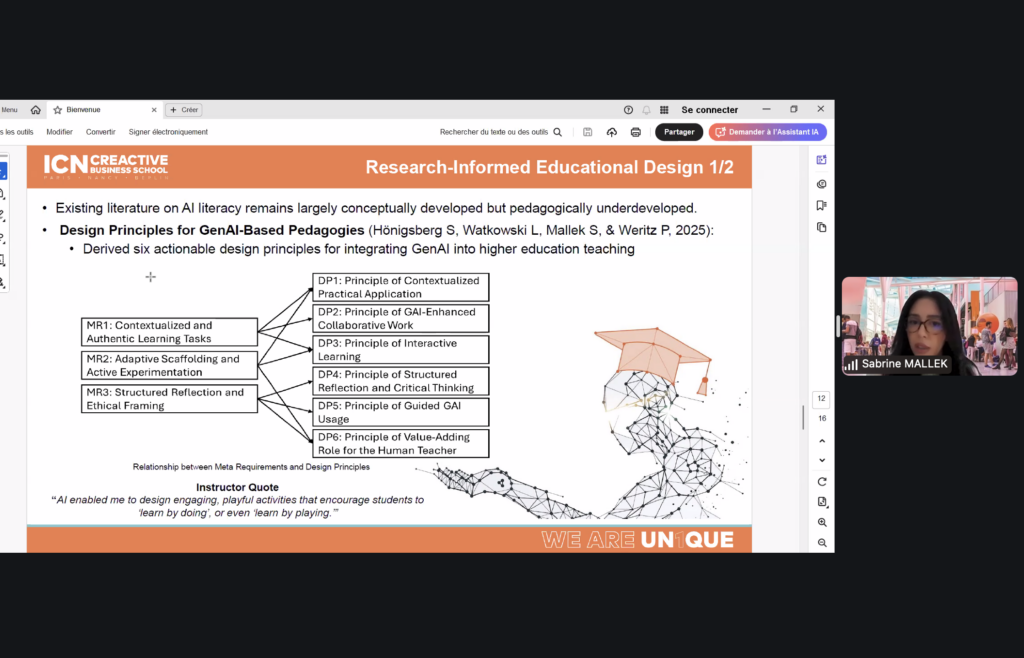
Sabrine Mallek outlined how rapidly expanding AI tools are challenging and reshaping educational practice. Her presentation introduced the Erasmus+ AIRED project, launched in 2024, which aims to equip educators across Europe with the skills and ethical frameworks required for responsible adoption of AI. The project’s output will be a free e-learning platform intended to strengthen functional, critical and socio-technical AI literacy among teachers from primary to adult education.
The AIRED project members surveyed 197 education professionals and conducted interviews with 15 practitioners. Their findings show that AI has already become an “amplifier of imagination” in classrooms. Educators described being able to produce interactive learning materials, simulations and visual assets in ways that would have previously been impossible due to time or resource constraints. Students likewise exhibited higher engagement and greater scope for experimentation.
Yet participants also identified risks: hallucinations, bias, ethical concerns and the absence of clear political frameworks. Mallek stressed that AI literacy is no longer optional. It must extend beyond familiarity with tools toward critical evaluation, ethical understanding and reflective usage.
At ICN Business School, she and her colleagues have developed a research chair integrating the art, technology and management philosophy. Within the framework of an AI literacy project, they design and study pedagogical uses of generative AI embedded directly into curricula. They use generative AI in assignments for more than 1,700 students, adopting roles such as “AI consultant”, “creative collaborator”, or “decision-support system”. Their research highlights that active design work produces significantly stronger literacy gains than passive tool use, leading to six concrete design principles for AI-enhanced teaching.
Mallek also introduced the “AI Battle” workshop, a collaborative card game designed by the associations Latitudes and Data for Good, enabling students to debate societal and environmental issues related to AI and to formulate actionable practices for responsible use.
Vitae: Sabrine Mallek
Associate Professor of Digital Transformation at ICN Business School and co-leader of its AI Chair. Her research focuses on AI applications in business, CSR and digital transformation. She leads European education initiatives, including the Erasmus+ ART project, and develops evidence-based pedagogical frameworks for AI literacy.
Isabelle Galy: Cultural Understanding as the Foundation for AI Literacy
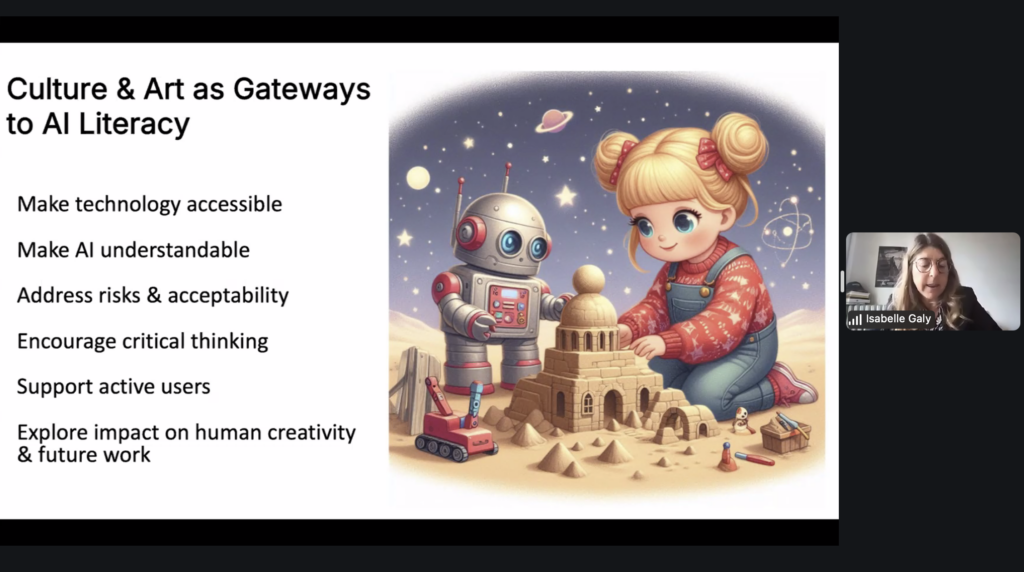
Isabelle Galy explored how artistic education and cultural literacy underpin any meaningful engagement with AI. She argued that without exposure to art and cultural complexity, young people risk perceiving AI-generated content as sufficient substitutes for artistic experience. AI can assist in explaining artworks or offering accessible entry points but should not replace the development of aesthetic judgement.
Galy described her pedagogical work at the House of AI in France, including collaborations with street artists using holograms, NFTs and AI to broaden access to creative expression. She emphasised that creativity must retain a human imprint even as models increasingly replicate stylistic signatures. For her, the essential question is whether societies can cultivate enough cultural awareness to distinguish artistic intention from commercial decoration.
In a joint project with the InteractionSeeds team, Galy introduced AI literacy to twelve- to fourteen-year-old pupils through poetry slam workshops. These aimed to demystify AI, highlight its limitations and foster emotional expression. Students concluded the programme with a sense of creative empowerment that Galy identified as central to responsible adoption.
Vitae: Isabelle Galy
Former CEO of the House of AI in Sophia-Antipolis, France. She works at the intersection of technology, art and education, developing creative formats to teach AI ethics and literacy to young learners and wider audiences. Her projects include collaborations with street artists and interdisciplinary workshops on creative practice in the age of AI.
Giannis Farsaris: Hybrid Art, AI Literacy and the Future of Learning
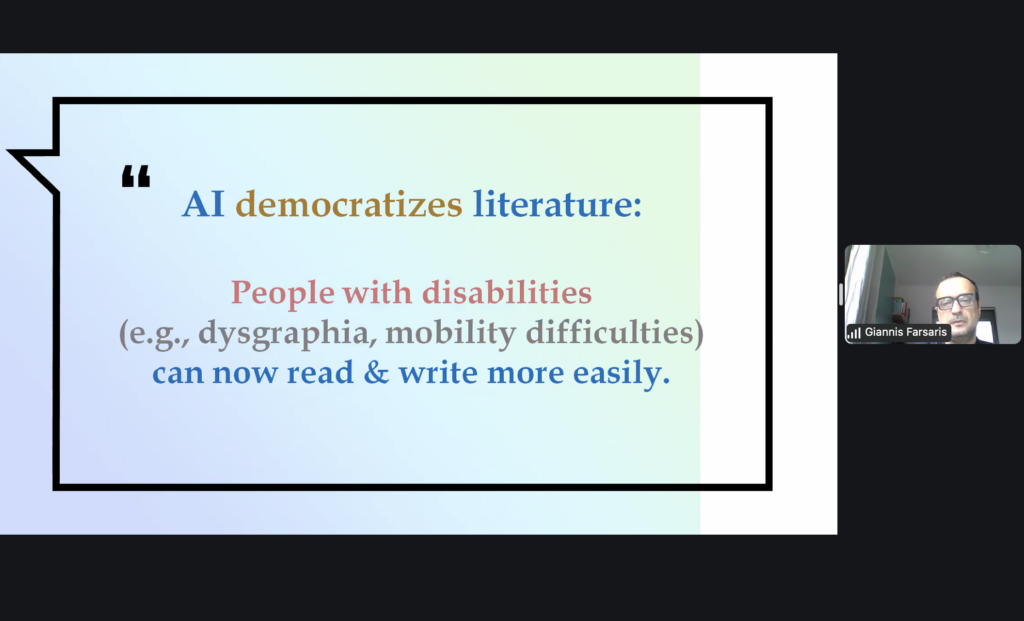
Giannis Farsaris offered a historical journey through writing technologies, from Mesopotamian tablets to the printing press, arguing that every technological shift has disrupted creative labour. He framed generative AI as another such inflection point, challenging but also expanding literary practice. Farsaris suggested that AI enables “synthetic art” and predicted the rise of three artistic categories: human, machine-generated and hybrid forms. He showcased his own hybrid book written collaboratively with ChatGPT to illustrate AI’s role as co-creator rather than competitor.
He also described how AI supports creative writing by generating ideas, alternative scenes and stylistic experiments, particularly valuable for students with fewer resources or those facing barriers to traditional writing. For him, AI is “the new ink, but the creative pulse remains human.
In the wider educational context, Farsaris argued for a comprehensive rethinking of curricula. Students should be assessed not by traditional essays but by the process behind their AI-supported work, including prompt construction and reflective understanding. Hybrid teaching methods that combine analogue and digital practices could help prepare learners for an environment where “ready knowledge” is instantly produced by language models.
Vitae: Giannis Farsaris
Computer science teacher at an adult vocational school in Greece, author of books on artificial intelligence and digital creativity, and Secretary of the Ethics Committee of the Hellenic Information Technology Association. His work focuses on AI literacy, creativity and hybrid authorship.
Re-watch the Webinar on YouTube
Key Discussion Points and Insights
During the concluding discussion, several overarching themes emerged:
1. The urgency of AI literacy across all age groups
Participants agreed that understanding AI’s limits, risks and ethical implications is essential for educators and students alike. Without such competencies, reliance on AI risks undermining critical thinking and cultural awareness.
2. Creativity as a human–machine partnership
Speakers stressed that AI can enrich creative processes rather than replace them, provided that pedagogical frameworks emphasise agency, reflection and intention.
3. The need to preserve cultural and artistic education
Galy warned that without exposure to art and cultural depth, societies could drift toward shallow AI-mediated aesthetics, blurring boundaries between decoration and art.
4. Rethinking assessment and learning formats
Farsaris proposed evaluating student work through the transparency of their AI-supported process rather than traditional deliverables, aligning education with emerging knowledge production paradigms.
5. Hybrid learning as a pedagogical direction
A model combining analogue creativity and digital experimentation could help young people develop adaptability, curiosity and ethical judgement.
Conclusion
The webinar underscored that AI’s growing presence in education and the arts requires more than technical proficiency. It demands cultural grounding, ethical literacy and pedagogical innovation. While AI can accelerate creativity and broaden access to knowledge, its value ultimately depends on human intention, critical engagement and the preservation of artistic and cultural depth.